
Florida’s 25% Roof Rule Explained: What Melbourne Homeowners Need to Know
By H&H Roofing & Repairs | Melbourne, FL | Florida Building Code & Storm Damage
After a storm, most homeowners expect a straightforward process: assess the damage, file the claim, make the repairs. What they don’t expect is a Florida Building Code regulation that can turn a localized repair into a mandatory full roof replacement, often at significant additional cost.
That regulation is commonly called the “25% Rule.” For years it was one of the most misunderstood — and financially painful, provisions in Florida’s residential building code. But critical changes passed in 2022 altered how this rule applies to many Melbourne-area homeowners, and most people haven’t heard about it yet.
This guide explains how the rule works, what changed with Senate Bill 4-D, what the “Magic Date” of March 1, 2009 means for your property specifically, and how to navigate the intersection of building code and insurance when you’re trying to restore your roof correctly and legally.
Related: Trying to decide on a full replacement after storm damage?
Read our guide: Roof Replacement Melbourne FL: Costs, Materials, and What to Expect From H&H Roofing
Where the 25% Rule Came From and Why It Caused So Many Problems
Florida’s roofing code didn’t arrive at this provision by accident. Following a series of devastating hurricanes that exposed serious weaknesses in the state’s housing stock, lawmakers and building officials sought a mechanism to upgrade aging roofs over time without requiring immediate wholesale replacement. The intent was sound: use code enforcement to gradually eliminate older, weaker roofing systems from Florida’s residential inventory.
Section 706.1.1 of the Florida Building Code (Existing Building) historically stated that if more than 25 percent of a roof section was repaired, replaced, or recovered within any 12-month period, the entire existing roofing system, or the entire roof section, had to be replaced and brought up to current code requirements.
In practice, this meant homeowners whose roof sustained 26% damage from a single storm event were legally required to replace the whole thing. Not because the remaining 74% was failing — often it was structurally sound, but because the code threshold had been crossed. Insurance claims increased, homeowners faced unexpected out-of-pocket costs, and many were pressured into unnecessary full replacements by contractors who didn’t explain the nuances of how “sections” were defined under the code.
The 2022 Update: What Senate Bill 4-D Changed
Passed in May 2022, Senate Bill 4-D introduced a critical exception that changed the equation for a large number of Florida homeowners. The core change: the mandatory 25% replacement rule now does not apply to roofs that were constructed, repaired, or replaced in compliance with the Florida Building Code 2007 edition — or any subsequent edition.
The 2007 Building Code is the governing standard here because it represented a significant upgrade in wind uplift resistance requirements. And that code edition officially went into effect on March 1, 2009, the date that now determines whether your roof qualifies for the exception.
The “Magic Date”: March 1, 2009
The single most important factor in determining how the 25% Rule applies to your property is the permit date of your last roofing installation. Here’s what each scenario means in practice:
✔ Permitted After March 1, 2009Your roof was built to the 2007 code or better, meaning enhanced wind uplift requirements were met at installation. Result: If 40% of your roof is damaged, you may legally repair only that 40%. The 25% mandatory replacement threshold does not apply. You are not required to replace undamaged sections. |
⚠ Permitted Before March 1, 2009Your roof was built to older standards. The SB 4-D exception does not apply to this property. Result: If damage to a roof section exceeds 25% within any 12-month period, the entire section must be brought up to current code. This typically requires a full tear-off and replacement of that section. |
How to find your permit date: Search your property address in the Brevard County building department records, or contact your local city permit office. If you’re in Melbourne, the City of Melbourne building division maintains a searchable permit history online. H&H can also assist with this lookup during a free inspection.
What Counts as a “Roof Section” and Why It Changes Everything
One of the most consequential, and least understood, aspects of the 25% Rule is that the percentage calculation doesn’t apply to your entire roof. It applies to a roof section, a term with a specific legal definition under the Florida Building Code. Misunderstanding this distinction has cost homeowners thousands in unnecessary replacements.
A roof section is a distinct area of the roof system separated by one of the following physical boundaries:
| Boundary Type | Example |
|---|---|
| Expansion Joints | Structural gaps that allow for building movement across a large structure |
| Elevation Changes | A split-level home where different roof planes sit at distinct heights |
| Roof Covering Type | Where asphalt shingles transition to a flat membrane or tile roof |
| Separation Walls | Vertical walls extending above the roofline, dividing distinct roof areas |
Important: Ridges (the peak of the roof) and hips (the sloping corners) do not create separate sections. On a standard gable roof, both slopes, front and back are treated as a single unified section for calculation purposes.
Example: A Palm Bay home with a flat roof over a rear Florida room and a shingle roof over the main living area has two distinct sections. If the flat roof sustains heavy damage from a named storm, the 25% rule may mandate its replacement, but the shingle roof on the main structure is a separate section and remains entirely unaffected by that mandate.

The Florida Matching Statute: When Building Code and Insurance Policy Diverge
The 25% Rule is a building code regulation. But your insurance policy operates under a separate body of law and the two don’t always point in the same direction. Understanding where they intersect can be the difference between a repair claim and a full replacement settlement.
Florida Statute 626.9744, commonly called the Florida Matching Statute, requires that if the materials used for a repair do not reasonably match the existing roof in quality, color, or size, the insurer must make reasonable repairs or replacements to adjoining areas to ensure a uniform appearance across the visible roof surface.
The Discontinued Shingle Problem
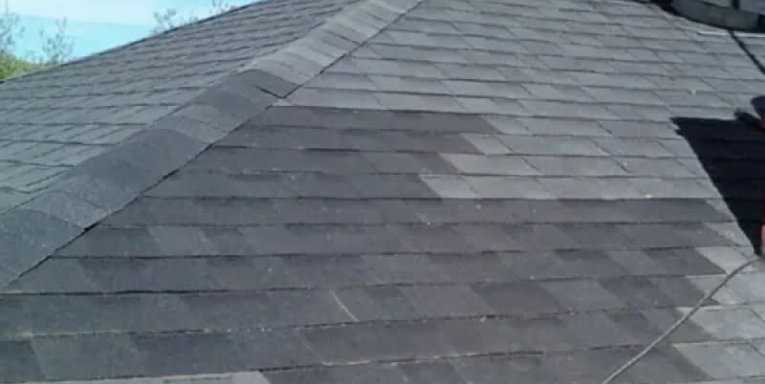
Roofing manufacturers update their product lines regularly, and color blends that were standard five years ago are frequently discontinued. A “Weathered Wood” shingle from 2015 may no longer be in production in 2026 — meaning a new shingle installed today won’t match the adjacent material in tone or texture, even from the same manufacturer.
When a repair would create a visible “patchwork” or checkerboard appearance, the Matching Statute may require your insurer to cover an entire slope or the full roof replacement to restore uniformity. This can flip a partial repair claim into a full replacement claim — entirely through the insurance channel, not the building code channel.
This is why it’s essential to verify whether your specific shingle type and color have been discontinued before agreeing to a repair scope with your adjuster. Missing this detail can leave significant money on the table.
Related: Wondering how Florida’s insurance market affects the repair vs. replacement decision for aging roofs?
See our breakdown in: Roof Repair vs. Replacement in Melbourne FL
How to Work Through This 25% Rule Decision: A Step-by-Step Framework
Determining the correct path for your property isn’t guesswork, it’s a systematic process. Melbourne and Brevard County homeowners dealing with storm damage or aging roofs should work through these steps before agreeing to any scope of work.
Navigating the Overlap Between Building Code and Insurance
The intersection of the Florida Building Code, Senate Bill 4-D, and Florida’s insurance statutes creates a layered environment where an incorrect assessment, in either direction can result in code violations, insufficient insurance settlements, or both.
Initial adjuster summaries don’t always account for the specific nuances of local code enforcement, section definitions, or discontinued materials. An adjuster working from a national playbook may not be familiar with how Brevard County’s High Velocity Hurricane Zone classifications affect the applicable code requirements. A detailed understanding of your permit history, the physical definition of your roof sections, and your shingle’s current production status are all required to ensure your home is restored correctly, legally, and to its full entitlement under your policy.
Ordinance or Law Coverage: Most homeowner insurance policies include “Ordinance or Law” coverage. If the 25% Rule mandates a full replacement that goes beyond the storm damage itself, this provision is designed to cover the additional costs required to bring the structure up to current code. Review your policy declarations or speak with your agent to confirm your coverage limits for this specific item — it’s often overlooked and underutilized.
Frequently Asked Questions About the 25% Rule
Get a Professional Assessment Before You Commit to Anything
The 25% Rule, the March 2009 Magic Date, the Matching Statute, Ordinance or Law coverage — navigating all of these correctly requires someone who understands both the letter of Florida’s building code and the practical realities of how Brevard County building officials apply it. Getting the assessment wrong in either direction has real financial consequences.
At H&H Roofing & Repairs, we’ve been helping Melbourne homeowners decode these regulations for over 30 years. Our inspections determine the precise age and code status of your roof system, document storm damage as a percentage of the affected section, verify matching material availability from current manufacturer inventories, and ensure every project is permitted and compliant with the High Velocity Hurricane Zone wind codes that apply throughout Brevard County.
We’ll tell you exactly where your roof stands and we’ll tell you the truth, even if the truth is that you don’t need to spend money yet.
Explore our services:
Roofing Services in Melbourne FL — storm damage inspection, repair, and full replacement for Brevard County homeowners.
Schedule Your Free Roof Inspection
We’ll assess your permit history, document the damage, and give you a straight answer on what the code requires and what your options are.
Or submit a priority request contact form — we respond promptly to all Melbourne FL inquiries.
H&H Roofing & Repairs
Address: 3721 Driftwood Dr, Melbourne, FL 32935
Phone: (321) 704-2174
Email: ed@hhroofingandrepairs.com
Website: hhroofingandrepairs.com
Location: Melbourne, FL — Serving all of Brevard County
Hours: Mon–Fri 7am–7pm | Sat 7am–5pm | 24/7 Emergency Service
License: #CCC1333557 | Licensed & Insured | BBB A+ Rated | 5.0★ Google Rating
